
AI-generated cabin concept, used for illustration.
In this guide
Compare the model and the offer separately. A floor plan tells you about the space; a quotation tells you what a supplier will provide. You need both, plus the local work, to judge which option fits your project.
Define the minimum brief
List the intended use, enclosed rooms, access needs and storage. Choose a consistent level of finish for the comparison. If one proposal includes a different arrangement, identify the difference instead of assuming that a similar area makes the plans equivalent.
Ask for dimensioned plans and sections. Clarify whether the published area includes low edges, lofts, stairs or other elements. Area definitions can differ, so a single price-per-square-metre number may compare unlike quantities.
Keep a dated model record
The Cozdena model comparator records three published AVRAME specifications checked on 16 September 2026. It shows the manufacturer's stated floor area, bedrooms, bathrooms and levels, with a link to each current product page.
For example, the current Trio 100 page lists 101.9 m², two floors and three bedrooms. Treat the linked product specification as the reference when an older article or saved image shows a different figure. Ask the supplier which revision applies to your quotation.
The comparator is deliberately narrow. It does not score local approval, structural suitability or finished cost, and it does not imply an affiliation with the manufacturer.
Build the inclusion matrix
For each offer, create rows for structure, exterior enclosure, windows, interior components, delivery, unloading, assembly and local professional work. Mark each row included, excluded, optional or unclear.
Keep “unclear” separate from “excluded.” It is a question to ask, not permission to assume the better interpretation. Attach the written response to the offer so the comparison remains traceable.
Compare the interfaces
Ask who provides the information needed by the foundation contractor and local designer. Find out when dimensions become fixed, how changes are agreed and what happens if site conditions require an alteration.
Also ask about delivery packaging, storage conditions and the process for damaged or missing items. A clear interface can be more useful than an attractive component list if several independent businesses must coordinate the build.
Bring the prices onto one basis
Keep the same currency and treatment of taxes, delivery and assembly. If conversion is necessary, record the date and actual rate you used in your own worksheet. Our calculator's currency selector changes the label only; it does not convert quotations.
Use the budget planner to add the local work and any excluded scope once. The kit-price explanation describes how double-counting can occur when one package already includes items listed separately in another.
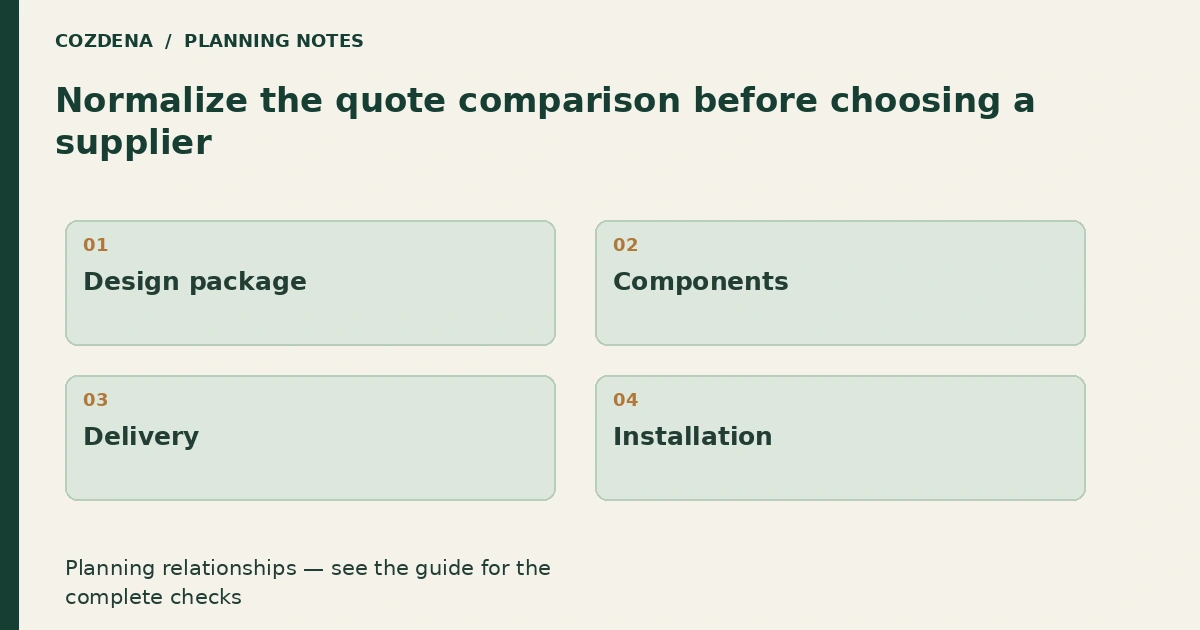
Normalize the quote comparison before choosing a supplier
Create a shared scope sheet and ask each supplier to mark included, excluded or allowance against the same items. Keep quoted currency, tax treatment, delivery destination and date visible. Do not compare a domestic collection price with a delivered imported package as though the totals describe the same purchase.
| Comparison line | What to clarify |
|---|---|
| Design package | Which drawings and project-specific reviews are supplied? |
| Components | Exact specification and approved substitutions |
| Delivery | Destination, unloading and storage responsibilities |
| Installation | Included labour and owner-supplied tasks |
| After delivery | Missing-item process and product documentation |
Leave an unresolved cell blank but flagged; zero implies that an item costs nothing. Ask for an updated written quote when a material assumption changes, and keep the earlier version for comparison.
Connect the selected offer to the procurement schedule, then use the receiving checklist to verify what arrives. This gives you a continuous record from the compared specification to the delivered components instead of a folder of unrelated PDFs.
Finish with a decision note
Write a short explanation of why the preferred option fits, which compromises remain and what must be confirmed before commitment. Keep the dated plans and quote beside that note. If an offer changes, compare the revision against the same brief rather than starting from its headline price again.