AI-generated cabin concept, used for illustration.
In this guide
Start an off-grid power plan with the equipment you expect to use and how long it runs. Daily energy use and the highest simultaneous power demand are different numbers; the system designer needs both.
Calculate an illustrative day
Energy in watt-hours equals watts multiplied by hours. Divide watt-hours by 1,000 to express the result in kilowatt-hours.
| Illustrative load | Calculation | Daily energy |
|---|---|---|
| Lighting | 30 W × 5 h | 150 Wh |
| Laptop | 60 W × 4 h | 240 Wh |
| Small fan | 20 W × 6 h | 120 Wh |
| Total for these three items | 150 + 240 + 120 | 510 Wh |
These are invented arithmetic inputs, not typical consumption claims. They exclude other equipment and system losses. Use measured or product-specific information for your own list; appliances that cycle need more careful estimates than rated power multiplied by every hour of the day.
Make a second list for simultaneous use
Mark which equipment might operate together and which loads have starting requirements. Ask the system designer how those demands affect equipment selection.
Your Home: batteries explains why storage selection involves the intended use and system arrangement. Its Australian market context does not supply local pricing or installation requirements elsewhere.
Keep an ordinary day, a busy day and an unattended day separate. The useful output is a transparent set of assumptions that can be checked and revised before anyone sizes the electrical system.
Add simultaneous use to the energy list
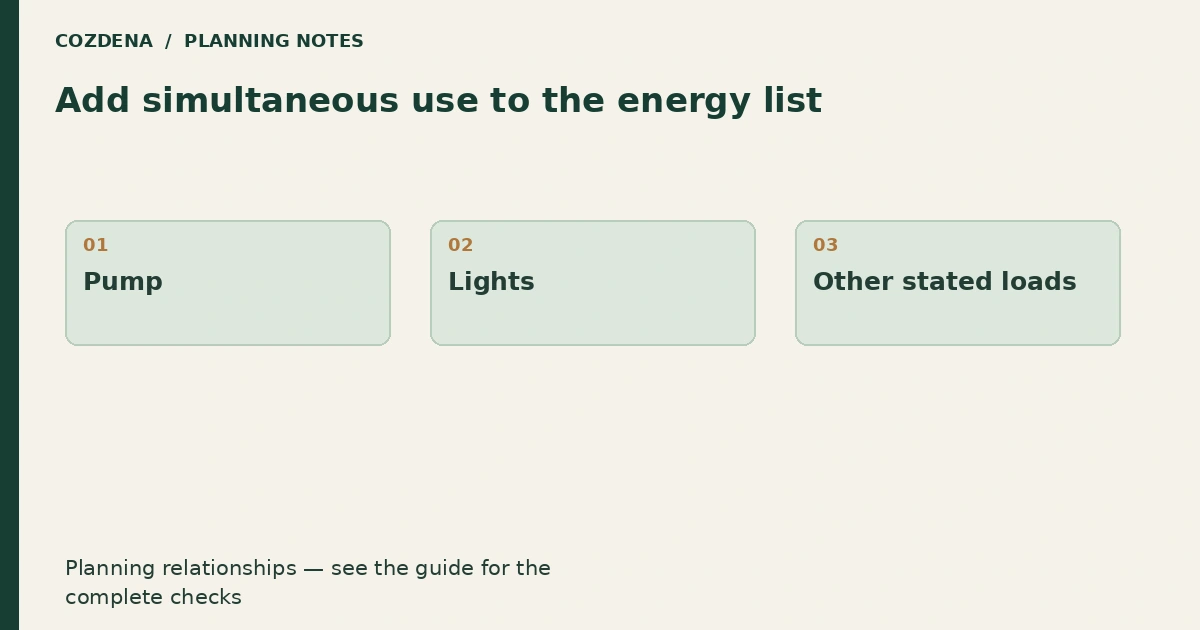
Daily energy and instantaneous power answer different questions. Keep runtime for battery-energy planning, then separately identify loads that can operate together and any starting requirements supplied by the manufacturer.
| Illustrative item | Running input | Assumed use | Energy |
|---|---|---|---|
| Pump | 500 W | 0.4 h | 200 Wh |
| Lights | 40 W | 5 h | 200 Wh |
| Other stated loads | Record individually | Record individually | Add separately |
Although the two sample rows use equal daily energy, their running power differs. A pump's starting requirement is another question; do not infer it from the 200 Wh total. These figures are illustrative and omit losses and the rest of the system.
Use the inverter running and starting power guide to prepare the equipment schedule. Add standby consumption and verify battery operating temperatures before comparing a complete proposal. The result should be a documented set of assumptions a qualified installer can review, not a single guessed battery size.