Planning diagram. Examples and assumptions are explained below.
In this guide
Give the system designer both the loads that may run together and any equipment-specific starting requirements. Daily kilowatt-hours alone cannot establish the inverter capacity you need.
Keep energy and power in different columns
Energy in kWh describes consumption over time. Power in kW describes the rate at a particular time. Two cabins can use the same daily energy while having very different peaks.
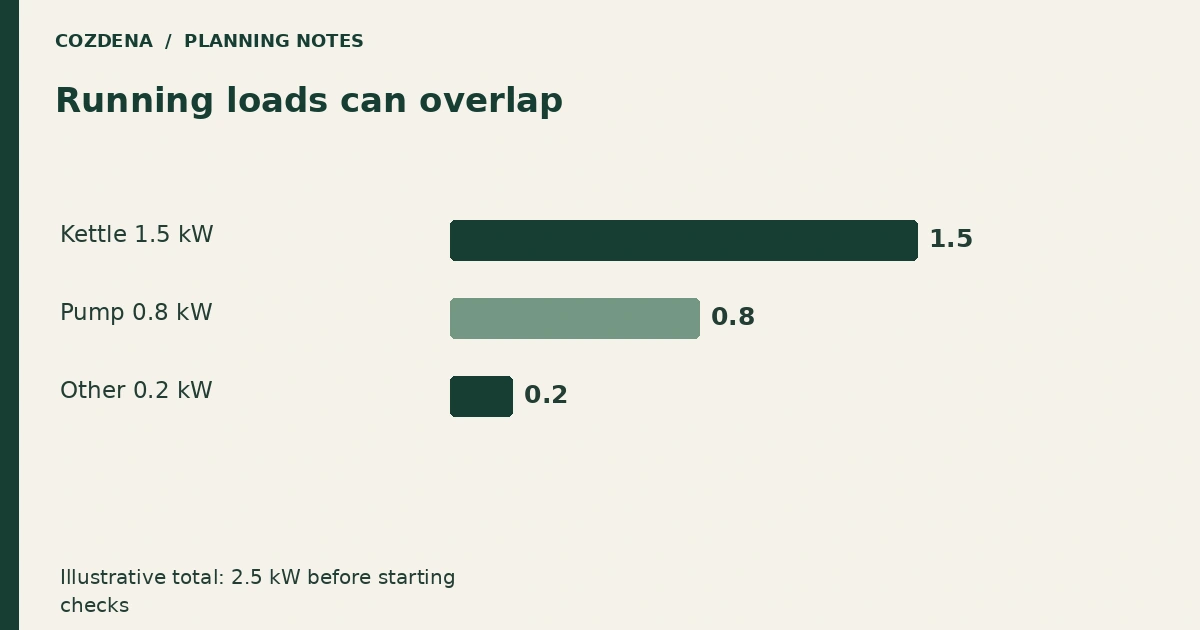
In an invented example, a 1.5 kW kettle operates alongside a 0.8 kW pump and 0.2 kW of other loads. The simple running-power total is 2.5 kW. That sum does not include any additional starting requirement or prove compatibility with a nominally 2.5 kW inverter.
Request equipment data
| Load | Running input | Starting requirement | Can overlap? |
|---|---|---|---|
| Water pump | Manufacturer or measured data | Manufacturer data | Check controls |
| Refrigerator | Appropriate operating data | Manufacturer data | Usually automatic |
| Cooking appliance | Selected setting or rating | Check product | Occupant controlled |
| Background equipment | Measured or specified | As applicable | Often continuous |
Ask the designer to check watts, volt-amperes and power factor where relevant, plus the inverter's allowed duration at any stated overload. A short peak rating and a continuous rating are not interchangeable.
Evaluate the whole power system
The battery, controls, protective equipment and wiring must also support the selected arrangement. Have a qualified installer design that system. This worksheet is not a wiring guide or a method for selecting cables and breakers.
Your Home's battery guide describes batteries as part of a wider conversion and control system. The inverter cannot be chosen independently of that system.
Decide whether loads can be managed
Perhaps one high-power appliance can be kept off while another runs. Record that as an explicit operating rule or have suitable automatic controls designed. Do not assume every guest will remember an unwritten limitation.
Ask what happens on overload, how recovery works and which essential loads remain available. Test the agreed operating scenarios at commissioning under the installer's supervision.
Use the energy cost calculator for energy scenarios, then keep the power schedule beside your off-grid load list. The battery-runtime guide addresses how long stored energy lasts, which is a separate sizing question.