Planning diagram. Examples and assumptions are explained below.
In this guide
Check the exact battery’s charging, discharge and storage temperature limits separately. A battery that can supply power in cold conditions may have a different permitted charging range.
Use the correct model's manual
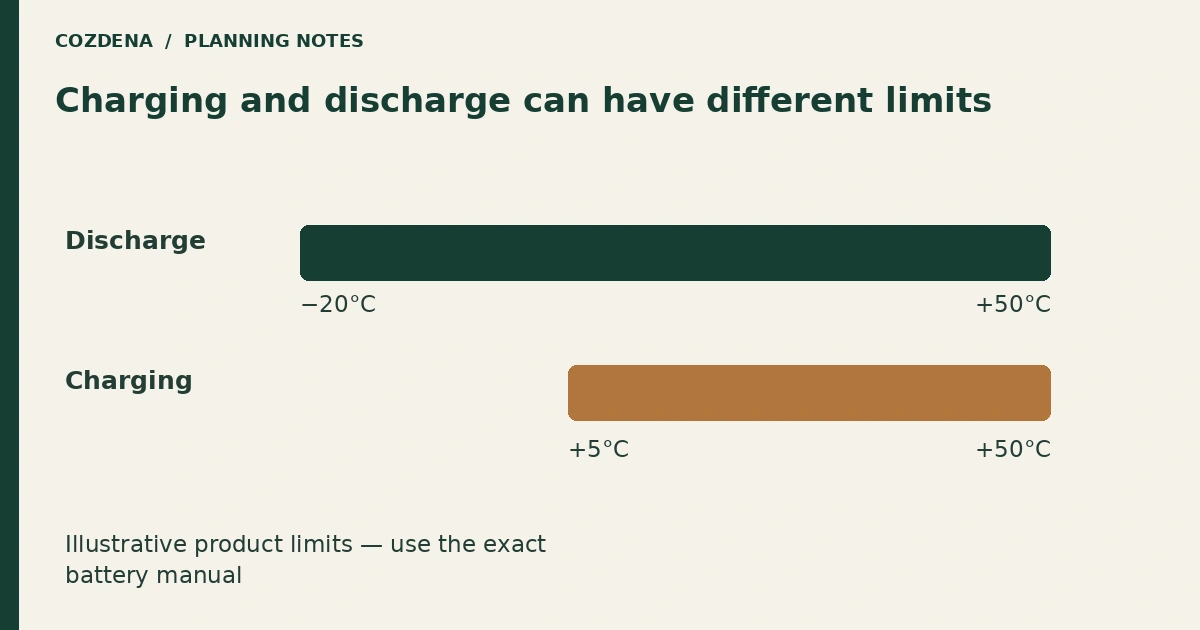
For a concrete manufacturer example, the Victron Lithium Smart operating manual specifies charging from +5°C to +50°C and discharge from −20°C to +50°C. Those are limits for the documented product family, not universal lithium-battery limits.
Other batteries, including models with integrated heating, can have different requirements. Record the full model number and manual revision before comparing them.
Check the location when nobody is there
An equipment cupboard that feels warm on a Saturday afternoon may cool after the cabin is closed. Give the installer the planned unoccupied heating settings and expected local conditions.
Ask where temperature is sensed, how charging is inhibited when necessary and what happens after a cold shutdown. Do not bypass battery-management protection or improvise a heater to force charging.
| Operating state | What to confirm |
|---|---|
| Occupied and warm | Permitted operation and service access |
| Cold and unoccupied | Temperature limits and required controls |
| Low solar production | How essential loads and reserves are managed |
| Return after shutdown | Manufacturer-approved recovery procedure |
Include auxiliary energy
If the approved system uses heating or other conditioning, include its consumption in the load assessment. Ask whether that load continues while the cabin is empty and how it affects the intended autonomy.
Also ask how cold conditions change available capacity for the selected battery. Do not treat the advertised nominal kWh as a guarantee of usable winter energy under every condition.
Request a handover scenario
Have the installer explain what you would see after several cold, cloudy days: the relevant readings, warning, automated response and person to call. Write the explanation using the labels shown on your monitoring screen.
Keep manufacturer instructions accessible offline. A QR code alone is inconvenient if the cabin loses internet at the same time as power.
Add these questions to the project checklist. Review battery capacity and runtime and standby electricity with the same operating assumptions. Temperature limits, energy capacity and power capability all need to fit the intended use.