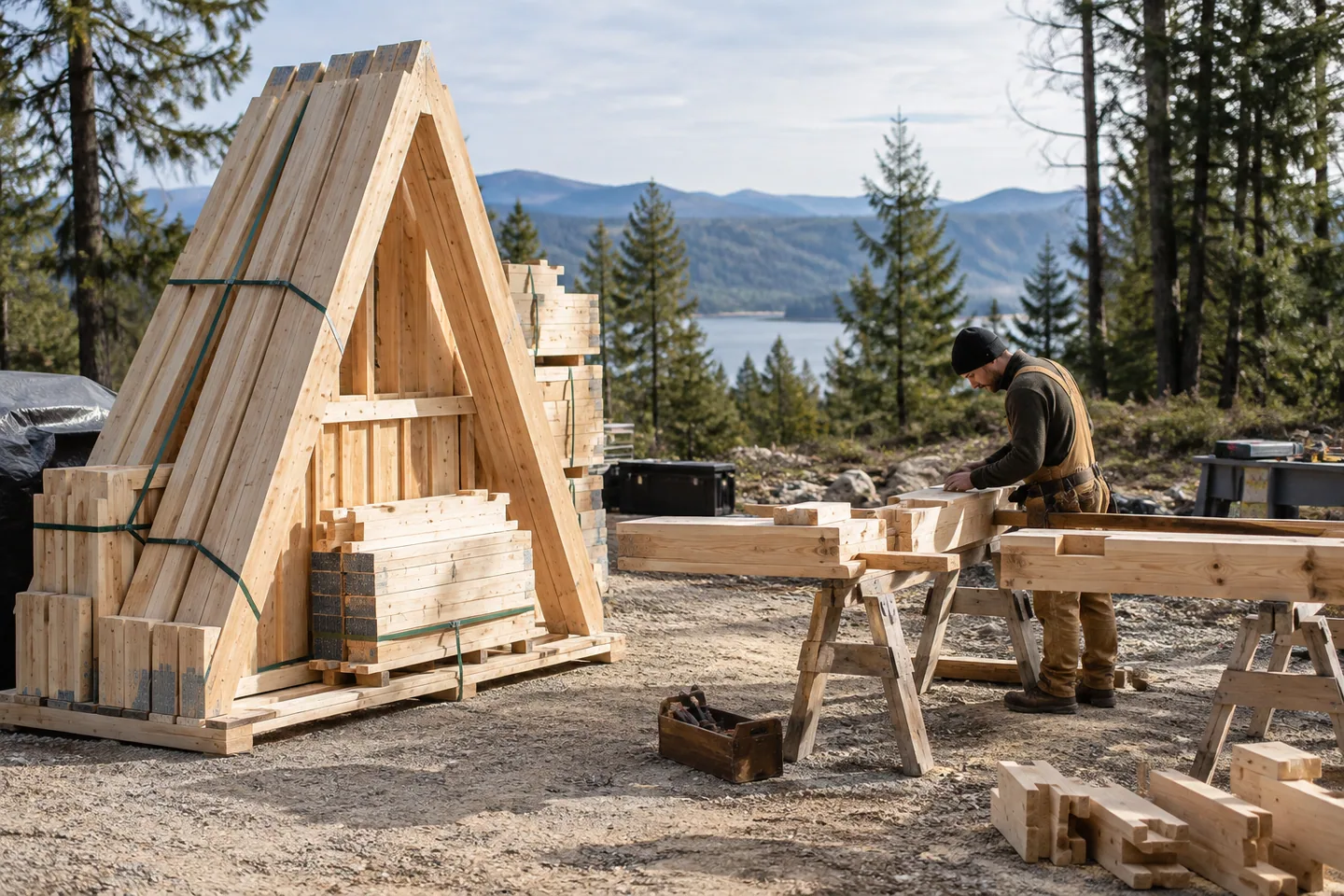
AI-generated cabin concept, used for illustration.
In this guide
A kit gives you a defined package to coordinate with the rest of the project. A custom build can start around a site-specific brief and a chosen delivery team. Either route still needs clear design responsibilities, local work and a complete budget.
Define the two offers you are comparing
“Kit” and “custom” are broad descriptions. A kit supplier may allow substantial layout changes. A contractor may offer a standardized design while taking responsibility for a large part of the completed building.
Look at the written scope instead of the label. Identify who prepares the drawings, adapts them to the site, supplies components and coordinates the installation. This is where meaningful differences begin.
Compare the work between packages
| Question | Kit route | Custom-build route |
|---|---|---|
| Starting point | A specified component package and model | An agreed brief and design process |
| Local design input | Confirm what must be added or adapted | Confirm what the appointed design scope includes |
| Site work | Often needs separate coordination; check the offer | May be included or separately contracted |
| Changes | Ask when component production becomes fixed | Ask how design and site changes are priced |
| Delivery | Resolve transport, unloading and storage | Resolve the contractor's supply and access arrangements |
| Final cost | Add all excluded work once | Check allowances and exclusions in the complete offer |
The table lists questions, not universal promises. The actual contracts can distribute these responsibilities differently.
Think about the decisions you want to control
If a published model already fits your needs, a kit may give you a useful starting point for discussion. If the site or household requires a very particular arrangement, compare the cost and consequences of adapting that model with developing another design.
Do not pay for customization before checking that the proposed change solves the problem. A wider room may affect several connected decisions, while a different storage or furniture arrangement may address your practical need more simply.
Test the coordination burden
Ask yourself how much project coordination you can realistically take on. Multiple independent suppliers mean someone must check their assumptions, sequence and interfaces. A broader contractor scope may change that responsibility, but only if the written agreement says so.
AVRAME's getting-started page provides one example of a kit model relying on local assembly labour. Read it as that supplier's approach, then obtain the current project-specific scope from whichever businesses you consider.
Bring both routes to the same finish line
Choose a clear completed state for comparison: installed services, finished rooms, agreed outside work and the documentation you expect at handover. Price both routes to that same point, including the assumptions that remain unresolved.
Use the budget planner and quote-comparison guide to organize the result. Choose the route whose responsibilities, design and cost you understand, rather than assuming one label guarantees a lower price or a simpler build.