
AI-generated cabin concept, used for illustration.
In this guide
A useful budget tells you what is included, where each amount came from and what is still unknown. Start with a written project scope, put every cost in one place and update the worksheet whenever a quote or design changes.
1. Define what the total must cover
Write a short description of the finished result: the intended use, rooms, approximate size, materials and services. Decide whether the total includes land, loose furniture, landscaping and any work outside the cabin.
You can choose different boundaries for your own worksheet, but label them. “Cabin cost” is too vague if one person means a kit and another means everything needed to move in.
2. Sort the costs by responsibility
The Cozdena budget planner uses separate lines for design and approvals, site and foundation work, the shell or kit, additional labour, exterior extras, services, interiors and delivery or equipment. Land and taxes sit outside that project subtotal.
For each line, keep a note containing the supplier, quote date, inclusions, currency and whether tax is included. If several contractors contribute to one category, keep their breakdown alongside the total. You should be able to trace the figure back to a document.
3. Make unknowns visible
Classify each amount as quoted, estimated by a named supplier or an allowance you have chosen. An unanswered question is not a free item. Record it in your planning checklist even if you temporarily use an allowance in the budget.
Do not use contingency to hide an entire missing scope. If the wastewater arrangement is unresolved, keep it as an explicit open decision. A reserve is easier to assess when the underlying work is reasonably defined.
4. Check for overlap
Read the kit schedule and contractor scope together. If glazing is already included in the shell price, do not enter it again under exterior extras. If a contractor's turnkey amount includes finishes, either keep that bundle intact and leave covered lines at zero, or obtain a breakdown that lets you allocate the same total consistently.
The tool adds the numbers you enter; it cannot detect that two invoices describe the same work.
5. Run a transparent example
The following figures are invented for arithmetic only. They are not a regional construction estimate or a supplier quote.
| Cost group | Example amount |
|---|---|
| Design and approvals | €6,000 |
| Site and foundation | €18,000 |
| Shell or kit | €40,000 |
| Additional assembly labour | €15,000 |
| Exterior extras | €10,000 |
| Services | €18,000 |
| Interior finishes | €20,000 |
| Delivery and equipment | €5,000 |
| Project subtotal | €132,000 |
A chosen 15% contingency adds €19,800. Adding €30,000 of land and €8,000 of separately entered taxes produces €189,800. The tool's “Load example” button uses these same numbers.
The 15% is an example input, not a recommendation for every project. Discuss an appropriate reserve and its basis with the people preparing your actual cost plan.
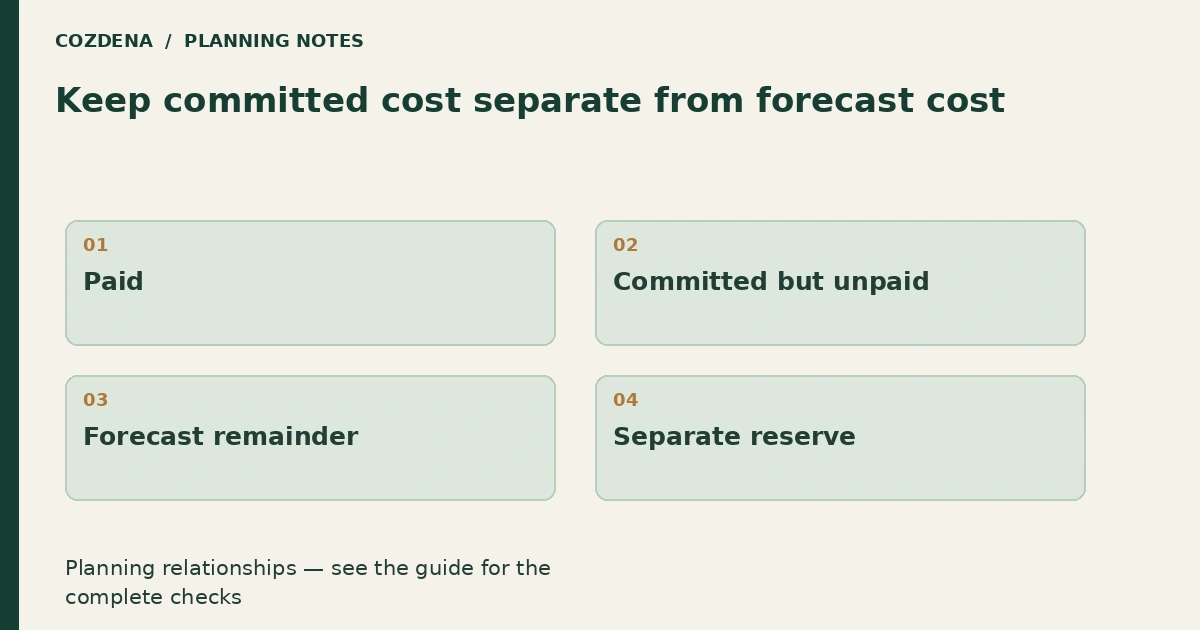
Keep committed cost separate from forecast cost
A useful budget shows what has been spent, what has been ordered and what remains an estimate. If you record only paid invoices, the project can appear comfortably under budget while large purchase commitments are already due.
| Budget column | Meaning |
|---|---|
| Paid | Money already paid for the project |
| Committed but unpaid | Agreed orders or work still to be paid |
| Forecast remainder | Estimated work not yet committed |
| Separate reserve | Allowance held for defined uncertainty |
In a hypothetical example, $40,000 paid plus $70,000 committed but unpaid plus $35,000 forecast gives a $145,000 forecast before the separately stated reserve. Do not add the full $110,000 commitment again if it already includes the $40,000 paid.
When a quote replaces an allowance, replace the relevant forecast line rather than adding both. Keep the old assumption in the notes so you can explain the change. Connect purchases to the long-lead schedule and use the site decision log to trace choices that change the budget.
6. Compare decisions without losing the baseline
Save one version of the budget before changing the glazing, adding a deck or choosing a different kit. Export the result with a clear filename and date. Compare the revised total with the baseline, but also record what changed in the scope.
Keep payment timing in a separate schedule based on real agreements. The budget planner gives a total; it does not show when funds must be available. Before making commitments, align both the cost plan and payment schedule with the actual offers.