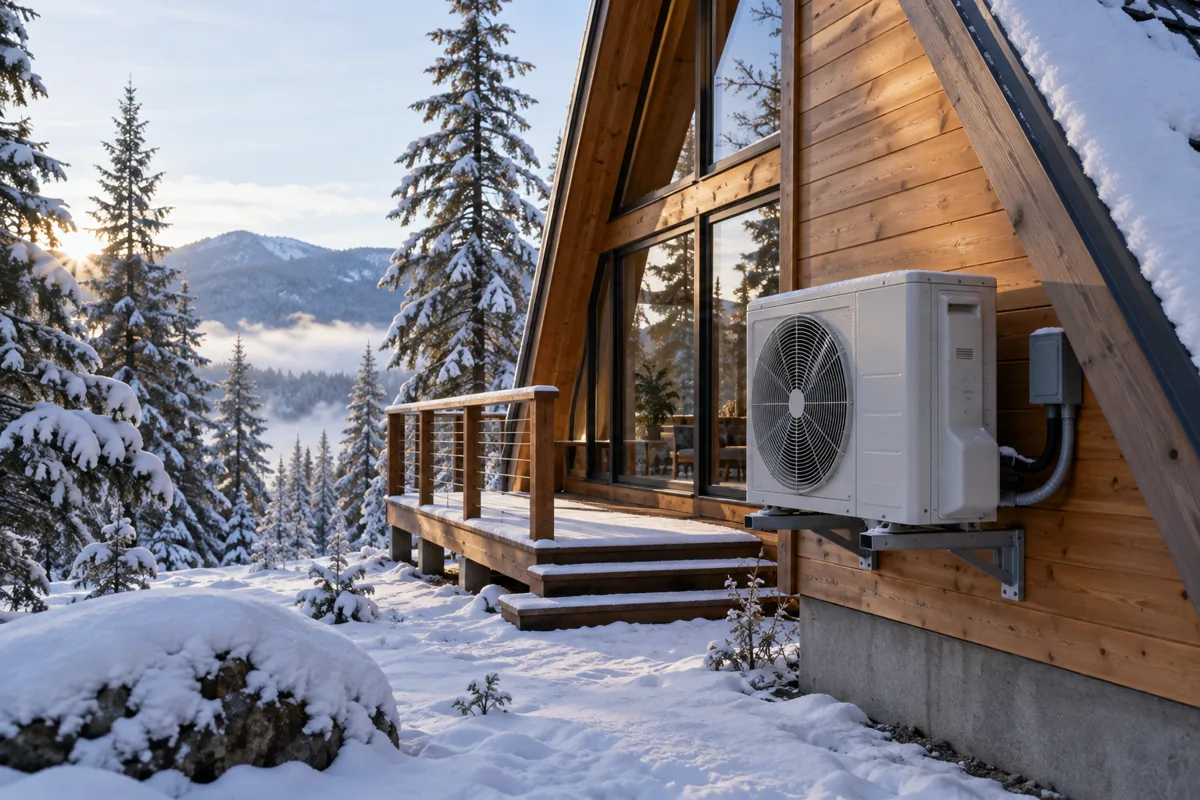
AI-generated cabin concept, used for illustration.
In this guide
Ask for the selected heat pump’s heating output at the cabin’s winter design temperature and compare it with a proper heat-loss calculation. A model name or nominal capacity is not enough.
Put the building requirement beside the equipment data
The ENERGY STAR heat-pump guidance recommends proper sizing and discusses cold-climate equipment. For a US project, ask the contractor for the applicable load calculation and the exact indoor–outdoor model combination.
An A-frame's large glazing, roof assembly, air leakage and room arrangement belong in that assessment. The floor area alone cannot describe them.
Use a comparison sheet with these separate rows:
| Item | What it tells you |
|---|---|
| Cabin design heat loss | Heat the building needs under the stated conditions |
| Heating output at that temperature | Heat the selected equipment can provide |
| Electrical input at that point | Electricity required under those test conditions |
| Minimum output in mild weather | How the equipment operates at lighter loads |
| Backup arrangement | What covers the agreed operating situations |
A capacity example
Suppose an illustrative heat-loss calculation gives 4.5 kW at the design condition. A hypothetical unit provides 3.8 kW at the same condition. The difference is 0.7 kW.
That comparison raises a design question about equipment selection or backup. It does not prove that any particular backup heater is suitable, and the numbers are not a specification for your cabin.
Now suppose the same unit's electrical input at that point is 1.9 kW. Its point-specific output-to-input ratio is 3.8 ÷ 1.9 = 2.0. Do not multiply 3.8 kW by your electricity tariff as though all heat output were electrical consumption.
Check what the quotation leaves out
Ask whether the proposed solution accounts for closed bedrooms, distribution between loft and ground floor, defrost behavior, outdoor-unit location and any auxiliary electrical loads. Request the assumptions behind an annual energy estimate separately.
Avoid comparing a seasonal efficiency rating directly with a single cold-weather operating point. Keep the test conditions and units attached to every number.
Use the energy cost calculator for clearly labelled input-power scenarios. Read the mini-split sizing guide for the building brief and the outdoor-unit winter siting guide before approving the installation location.