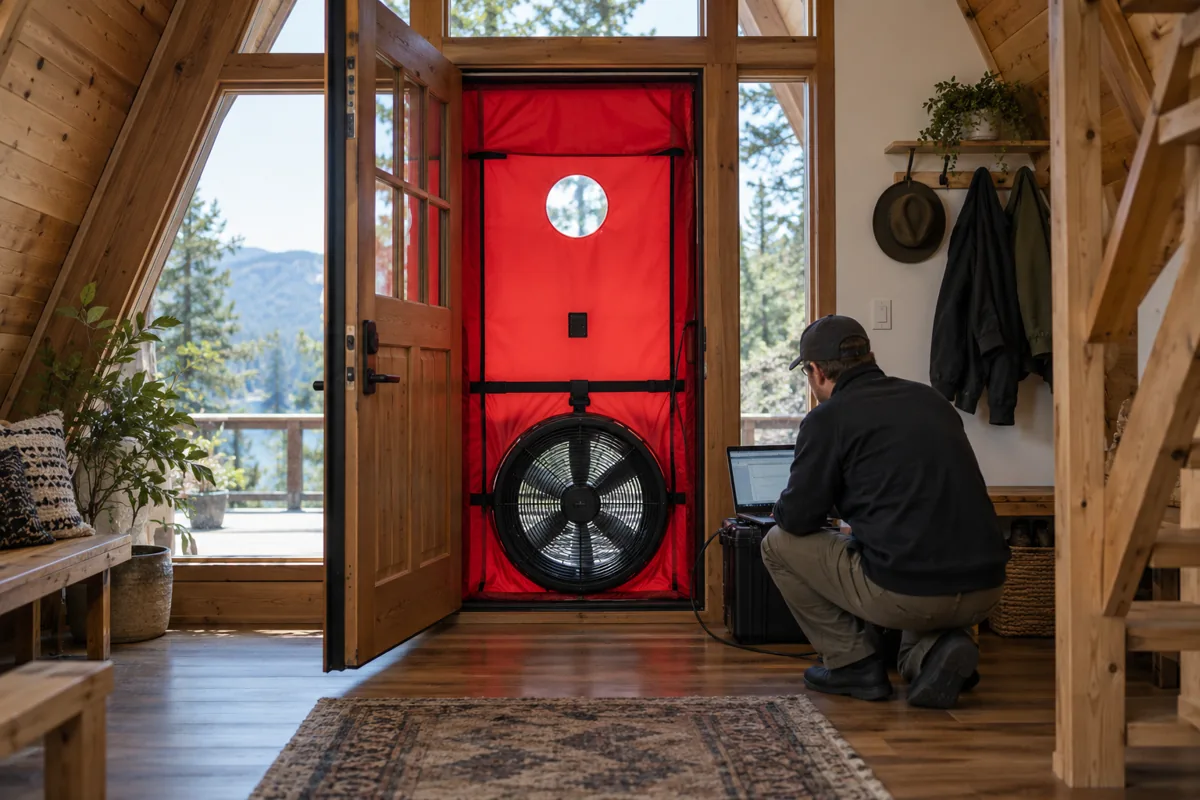
AI-generated cabin concept, used for illustration.
In this guide
Agree the airtightness target and test schedule before construction closes the air barrier. An early diagnostic test can reveal accessible leaks; a final test records the completed building’s performance.
What the test measures
A blower-door test uses a calibrated fan and a pressure difference to measure building leakage. The Your Home airtightness guide describes results expressed as air changes per hour at 50 pascals, or ACH50. That test condition is different from ordinary ventilation while you occupy the cabin.
Do not compare two ACH50 results without checking what building volume and test method were used. A tall A-frame contains a different air volume from a flat-ceiling room with the same footprint. Ask the tester to record the volume calculation, preparation method and relevant standard.
Choose a useful stage
The best early date depends on the assembly. The air-control layer must be sufficiently complete for a meaningful test, while key junctions should remain reachable for repairs. Ask the designer, builder and tester to agree that stage together.
For example, sealing a missed junction behind an unfinished service cavity may be straightforward. Finding the same gap after cabinetry and timber lining are installed can create extra work. An early result does not replace whatever final test your contract or jurisdiction requires.
Read the arithmetic without over-reading it
In a hypothetical test, leakage is 600 cubic metres per hour and the agreed internal volume is 200 cubic metres:
600 ÷ 200 = 3 ACH50.
This is an arithmetic illustration, not a recommended target or a prediction of normal outdoor-air exchange. A result by itself also does not identify every leak or establish the quality of insulation.
Ask for:
- The measured result, units, date and building volume.
- The agreed target and whether it was met.
- Photos or notes locating important leakage paths.
- A repair list with a responsible person and retest decision.
- Confirmation that ventilation and combustion-safety matters have been addressed by the appropriate professionals.
Close the loop
Keep the initial and final reports together. If a result changes after remedial work, you should be able to identify what was repaired. Avoid commissioning a test merely to collect a number with no agreed response.
Put the dates in the project checklist alongside the cabin commissioning plan. Before tightening an existing building, review its fresh-air ventilation plan.