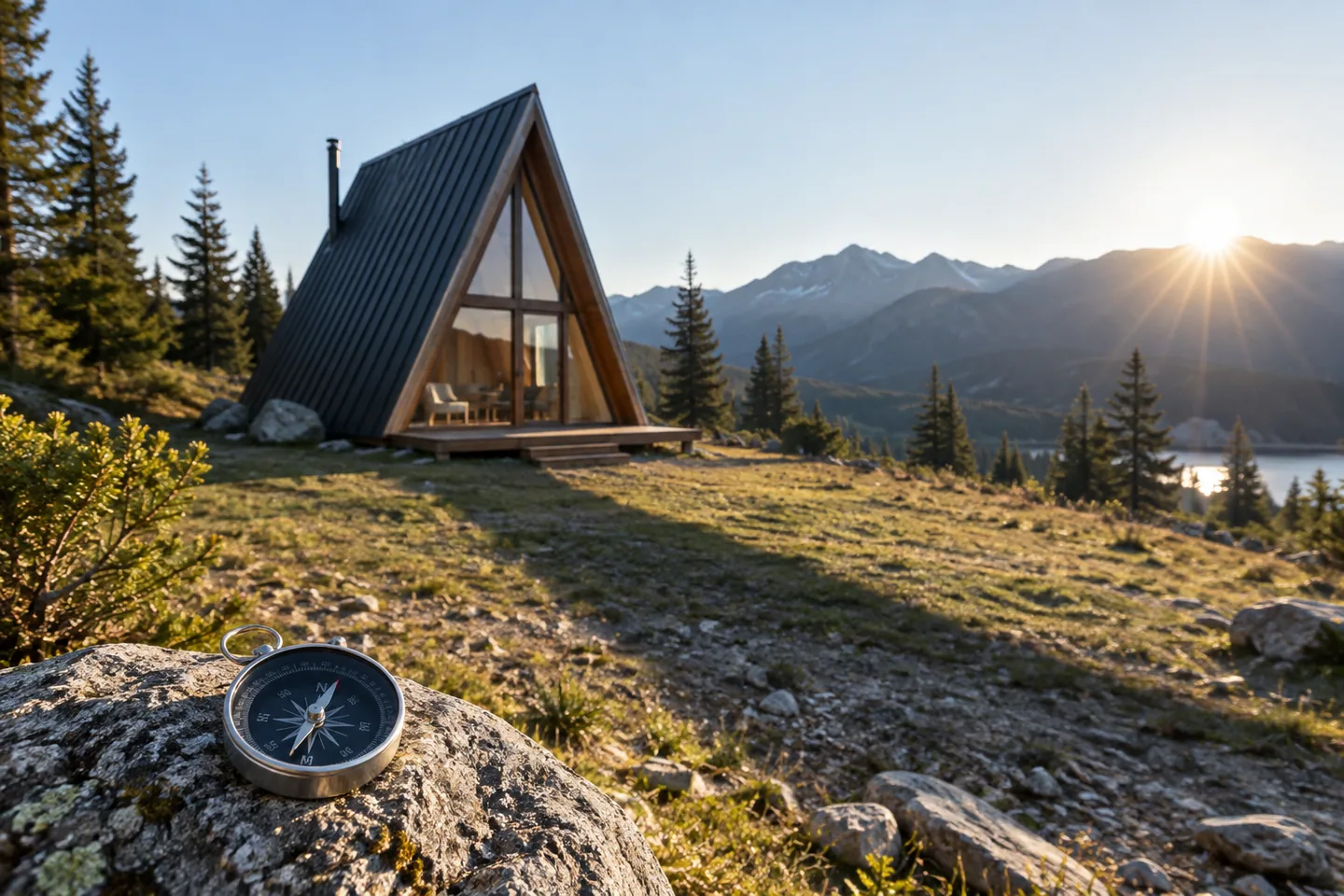
AI-generated cabin concept, used for illustration.
In this guide
Orient an A-frame for its actual site, climate and use. A north-facing recommendation from an Australian guide should not be copied literally into a northern-hemisphere plan.
Translate the principle, then test the site
Your Home: orientation explains the relationship between orientation, sun and building design in an Australian context. The useful principle is to examine the local sun path and desired seasonal behavior, not to copy a compass label.
Ask the designer to consider surrounding terrain, trees and nearby buildings as well as the open-sky direction. The best theoretical orientation may be constrained by access or the buildable area.
Compare the occupied rooms
Place the same cabin in two plausible orientations on the site plan. Review daylight, unwanted sun, shading and the views from important activities. Include the entrance and outdoor living area in the comparison.
For an illustrative tradeoff, the preferred view may bring sun exposure that needs a different window or shading strategy. You do not necessarily have to lose the view, but the whole arrangement needs review.
Keep any solar-equipment placement with the relevant specialist rather than assuming the window-wall orientation also determines the best equipment layout.
A useful orientation decision explains the tradeoffs for this parcel. It should connect the cabin's position to how the rooms will feel and function, rather than rely on a single universal direction presented as correct for every A-frame.