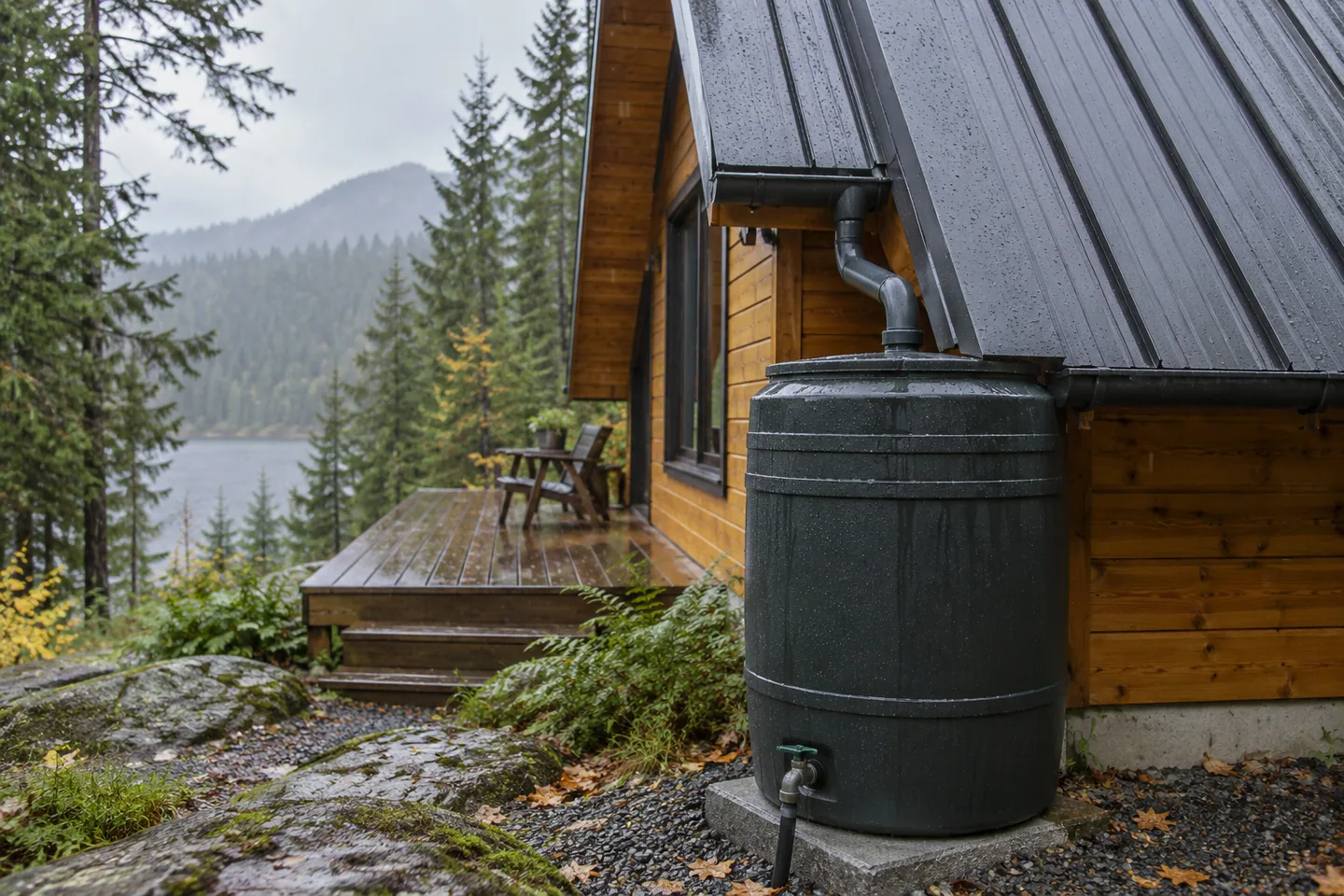
AI-generated cabin concept, used for illustration.
In this guide
For a simple estimate, multiply the horizontal roof area that drains to the system by rainfall depth and a collection-efficiency factor. In metric units, one millimetre of rain over one square metre corresponds to one litre before losses.
Use the horizontal catchment area
A steep roof has more sloping surface than its horizontal projection. That extra sloping area should not be substituted into a basic rainfall calculation. Use the plan area contributing to the collection system and exclude roof sections that drain somewhere else.
The roof surface calculator answers a materials question. The rainwater calculator answers a collection-potential question. Keeping their inputs separate prevents an apparently precise but overstated result.
Choose the rainfall period
Use an appropriate local rainfall source and label the period: a month, season, year or particular event. An annual average hides the timing of supply. A cabin can receive plenty of rain in one season and little during the period when you intend to occupy it.
Keep the rainfall source and date with your worksheet. Try more than one plausible scenario instead of assuming that a long-term average will occur in the next year.
Account for losses transparently
The Texas Water Development Board's rainwater guidance presents a catchment calculation using area, rainfall and a collection-efficiency allowance. In your own estimate, label the factor as an assumption and have the actual system's losses assessed.
Losses can depend on how the system operates, and a simple percentage does not model every event. Our default 80% input is an illustrative starting value, not a guarantee of what a particular installation will collect.
Work through the numbers
Suppose 60 m² of horizontal catchment receives 100 mm of rain during the chosen period. At an assumed 80% collection efficiency:
60 × 100 × 0.80 = 4,800 litres.
That is about 1,268 US gallons. The imperial input option converts square feet and inches to the same metric calculation, so equivalent inputs produce the same volume. The tool explicitly uses US gallons, not imperial gallons.
Do not treat the result as the tank size
A tank can overflow during a large event and be empty later. Useful storage depends on the timing of rainfall, demand, available capacity and the way the system is operated. A total-volume calculator cannot resolve those interactions.
Take the collection scenarios and a demand schedule to a suitable local designer or supplier. Ask what information is needed to assess storage and reliability for your intended use.
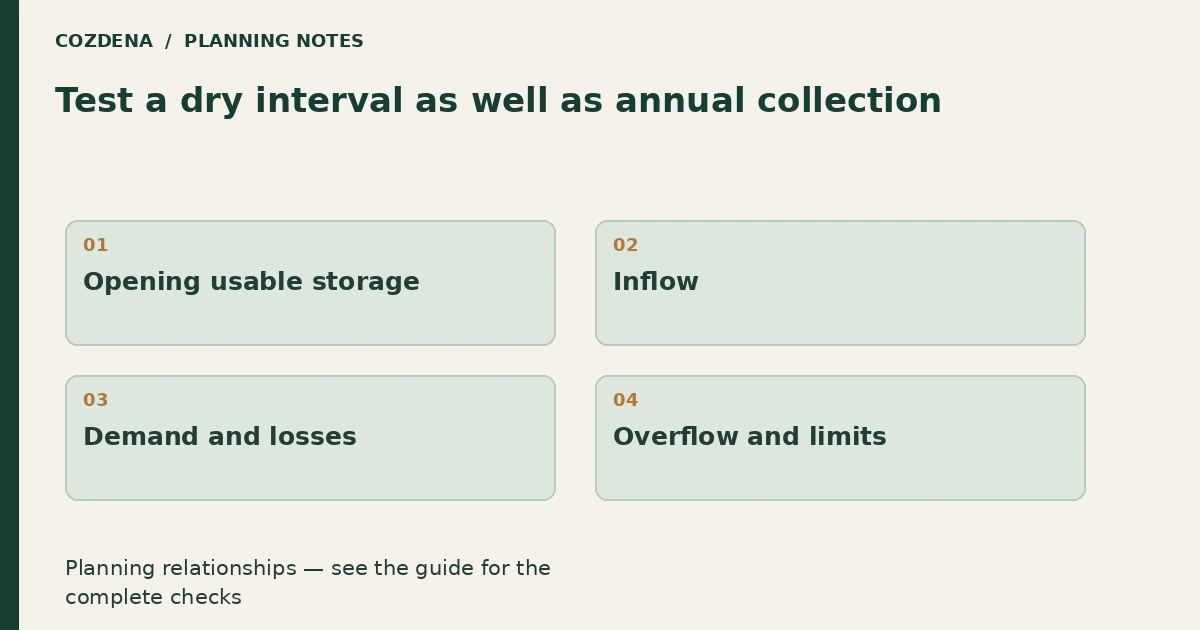
Test a dry interval as well as annual collection
A yearly rainfall total does not show whether the tank can supply a particular occupied weekend. Track collection and demand over a sequence of days, carrying the remaining stored volume forward.
Suppose a hypothetical tank holds 600 L before a dry interval and the cabin uses 120 L each day with no inflow. After four days, 120 L remains before other losses or unusable volume. Increasing annual collection elsewhere in the year does not change that particular interval unless the system can store and retain the extra water.
| Daily record | Purpose |
|---|---|
| Opening usable storage | Start from the previous day's result |
| Inflow | Add collection under stated assumptions |
| Demand and losses | Subtract the relevant uses |
| Overflow and limits | Keep storage within actual capacity |
Use the daily storage worksheet for a fuller example. Then check pump electricity and first-flush versus filtration as separate system questions. Collected volume says nothing by itself about whether water is suitable for drinking.
Keep water quality separate
Collected rainwater is not automatically drinking water. The CDC explains potential contamination and treatment considerations. Check local requirements and obtain advice for the intended use, treatment and testing.
For an off-grid cabin, record rainwater as one service decision among several. A promising volume estimate should not settle the water plan before seasonal reliability and quality have been addressed.