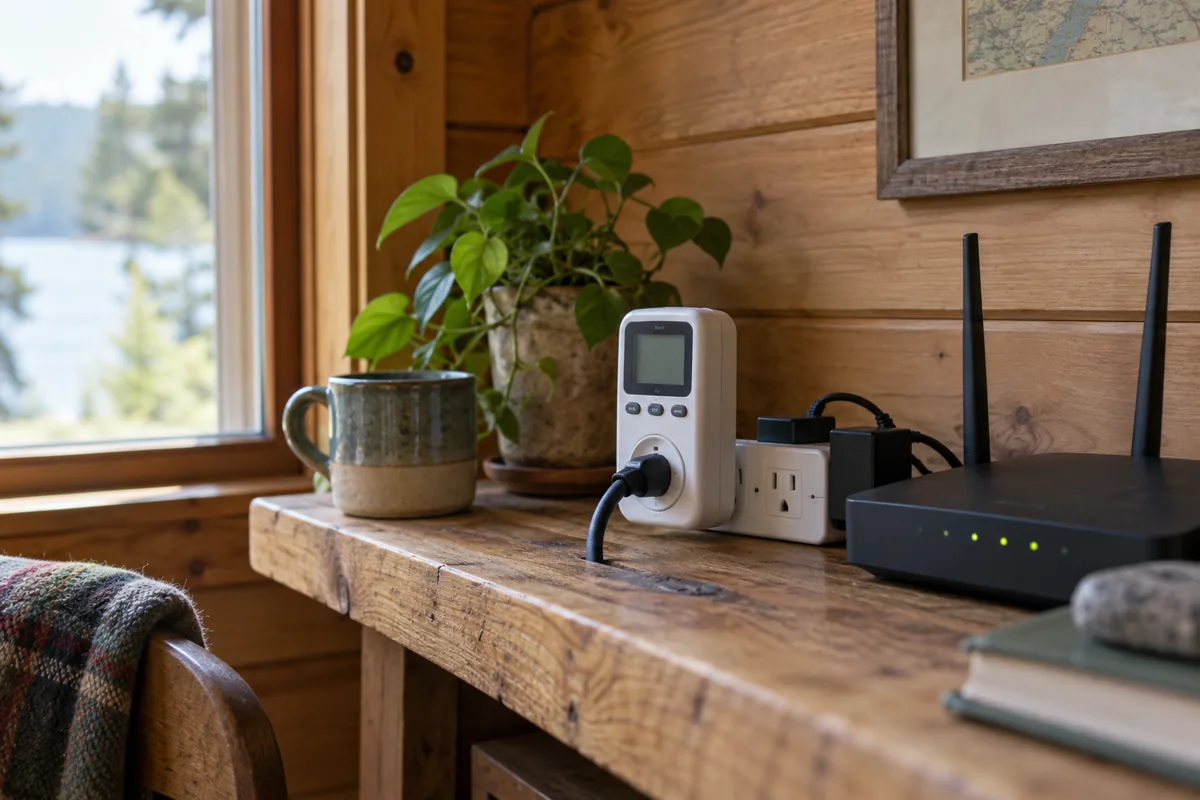
AI-generated cabin concept, used for illustration.
In this guide
Look at an empty-cabin period in your meter data and make a list of equipment still running. A small continuous load can use more energy over a month than a larger appliance used briefly.
Start with a documented empty period
Choose dates when nobody stayed and note any contractor visits. Record whether heating, water heating, refrigeration, ventilation and communications remained active. “Nobody was there” does not mean the building had no useful energy needs.
If the meter reports interval data, look for a steady background and repeated cycles. Use those patterns to form questions, not to identify an appliance with certainty.
Work out the continuous-load arithmetic
An illustrative constant 35-watt load uses:
35 ÷ 1,000 × 24 × 30 = 25.2 kWh in 30 days.
At an invented $0.25/kWh energy rate, that is $6.30. The same power running only eight hours per day would use 8.4 kWh over those 30 days. Duration explains the difference.
Use the energy cost calculator to compare your measured loads. Do not use a peak nameplate rating as though it were a measured constant draw.
Classify before switching things off
| Equipment group | Review question |
|---|---|
| Freeze protection and controls | What must remain active for the agreed winter plan? |
| Ventilation and moisture control | What unoccupied setting is approved? |
| Router and monitoring | Which alerts depend on this connection? |
| Entertainment equipment | Can it be turned off under its instructions? |
| Chargers and accessories | Are they doing anything needed between visits? |
Have the system provider explain dependencies. Turning off a router may also remove thermostat or leak notifications. Turning off a control may affect equipment that appears unrelated.
Measure safely and compare like periods
Use only measurement equipment appropriate to the appliance and electrical arrangement. Have an electrician handle hardwired circuits and any work at the electrical panel. Do not open equipment to obtain a reading.
After an agreed change, compare similar weather and occupancy periods. A lower bill during a warmer month does not by itself prove that one small device caused the saving.
Keep your equipment list with the off-grid load worksheet, even if the cabin is grid-connected. For battery systems, the Victron operating manual illustrates why residual loads matter during storage; use your own battery manufacturer's shutdown instructions. Also review unattended-cabin checks before changing what stays powered.