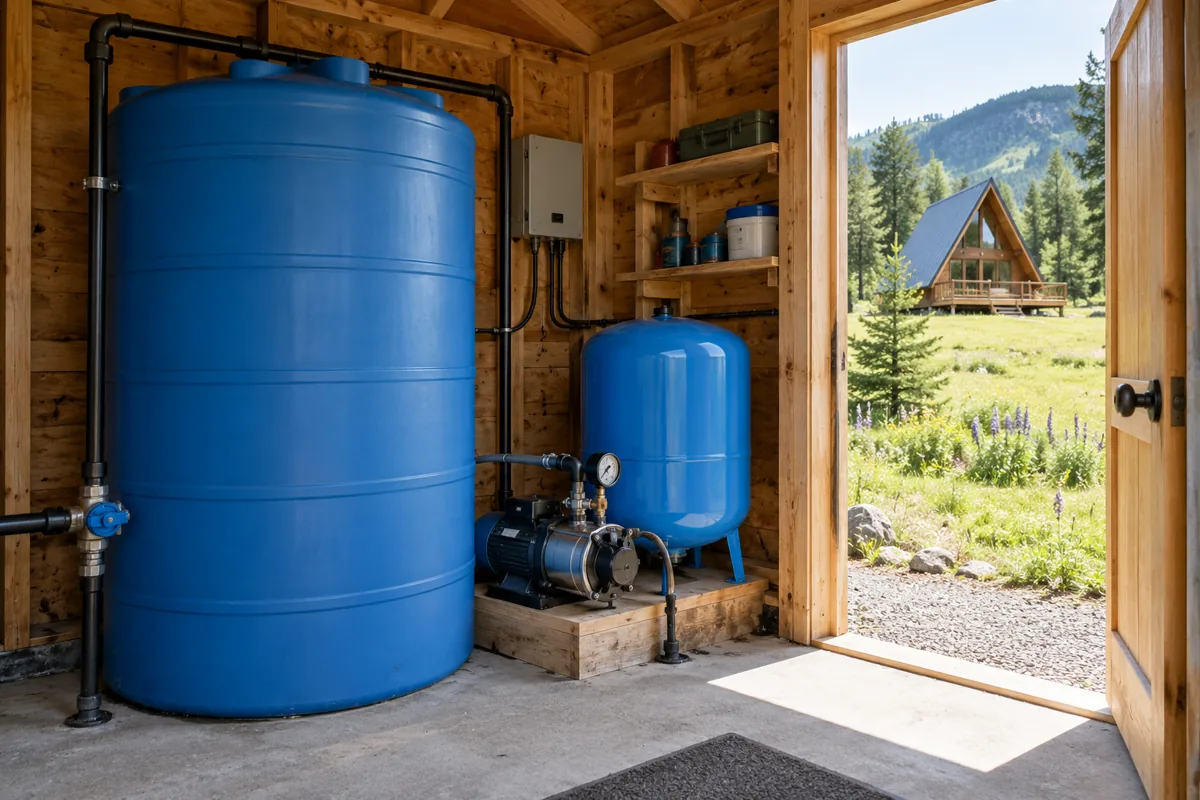
AI-generated cabin concept, used for illustration.
In this guide
A well’s tested yield, the water available in storage and the pump’s delivery rate answer different questions. Ask a qualified well professional to assess all three against your cabin’s demand.
Three numbers, three meanings
Yield concerns the source and the conditions of the test. Usable storage is the water the system can actually draw on. Pump delivery concerns water supplied at the required operating conditions. A large pump does not by itself prove that the source can sustain its output.
Collect the original well report and any later pumping tests. Ask the professional what they establish, what seasonal uncertainty remains and whether further testing is needed. Do not extrapolate a brief informal observation into a year-round supply guarantee.
An illustrative demand gap
Imagine a simplified scenario in which a source contributes 3 litres per minute while a ten-minute use requires 10 litres per minute. The difference during that period is:
(10 − 3) × 10 = 70 litres.
That arithmetic shows the role storage might play. It does not specify a tank size: the example omits usable drawdown, recovery timing, pump controls, reserves and water-quality requirements.
Ask what happens if another similar use follows immediately. A buffer that covers one shower may not cover a full guest morning.
Put the daily and peak questions together
| Question | Evidence to request |
|---|---|
| Can the source meet the intended use? | Suitable well-test interpretation |
| Can short peaks be supplied? | Storage and delivery assessment |
| What happens in a dry season? | Local evidence and contingency plan |
| How is water quality maintained? | Testing and treatment plan |
| What needs servicing? | Access and operating instructions |
The EPA's private-well resources provide a starting point for locating appropriate state and local help. Water quantity and drinking-water quality should remain separate decisions.
Design for the person maintaining it
If additional storage is proposed, review its location, cleaning arrangements, controls, overflow and winter conditions. Ask for a clear explanation of how the system responds to low supply, rather than assuming every storage tank can be connected the same way.
Record the open questions in the project checklist. Compare the proposal with the water tank demand guide and the pressure versus flow explanation. Those worksheets help you prepare the brief; the well professional must establish the actual design.