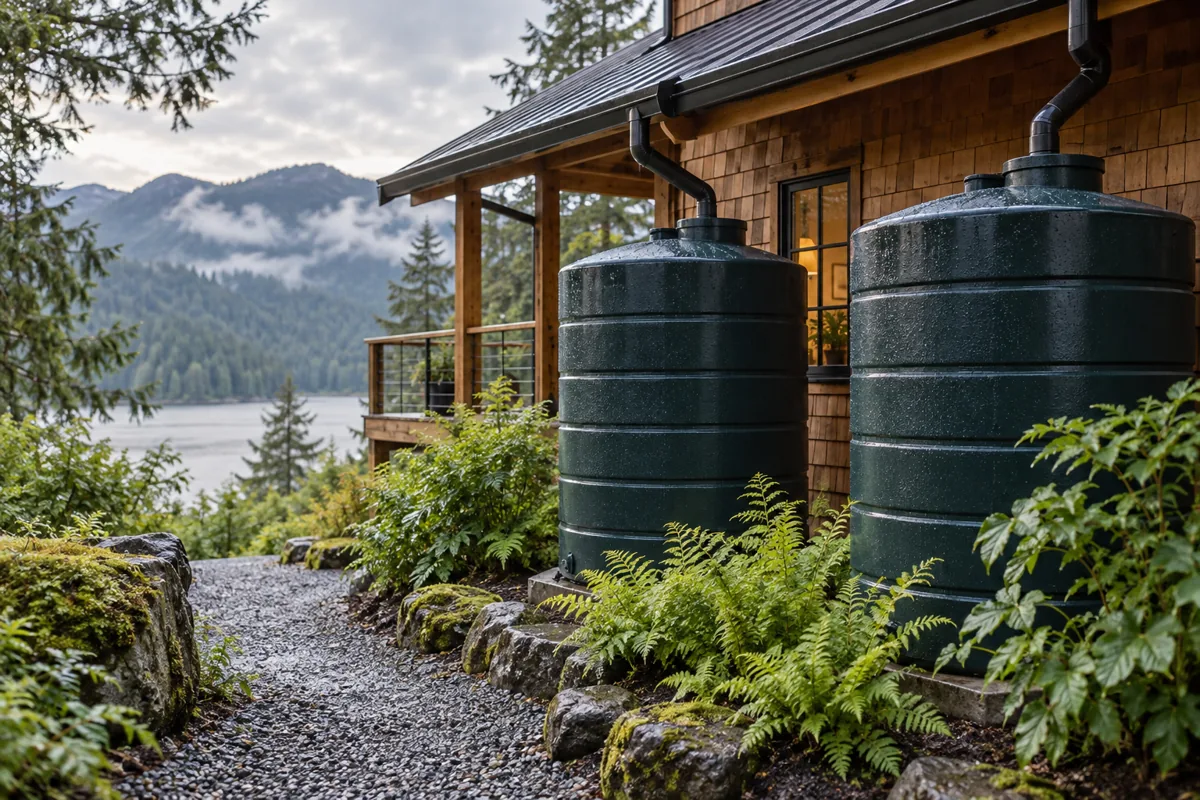
AI-generated cabin concept, used for illustration.
In this guide
Track the tank one period at a time: starting water, captured inflow, overflow, demand and ending water. This makes timing visible instead of assuming every litre of annual collection can be used.
Define a sequence before calculating
The example below assumes rain arrives before that day's demand. That is a simplifying choice. A storm arriving after a morning shortage could produce a different result, so use a shorter time step where the sequence matters.
For each day:
- Add captured inflow to the starting storage.
- Cap storage at the tank's usable capacity and record overflow.
- Subtract the day's demand, down to zero.
- Record any demand that could not be supplied.
“Usable capacity” should come from the actual system design. It may differ from the tank's advertised volume.
Work through three invented days
Assume 1,000 litres of usable storage, initially holding 700 litres. The inflows already include an assumed collection loss.
| Day | Start | Inflow | Overflow | Demand | End | Unmet demand |
|---|---|---|---|---|---|---|
| 1 | 700 L | 600 L | 300 L | 250 L | 750 L | 0 L |
| 2 | 750 L | 0 L | 0 L | 250 L | 500 L | 0 L |
| 3 | 500 L | 0 L | 0 L | 600 L | 0 L | 100 L |
The example both overflows and runs short. Adding the three-day inflow alone would hide that sequence.
Use local data for a real decision
Replace the invented inflows with a suitably detailed local rainfall record and the contributing horizontal roof area. Build a demand schedule from intended uses, including guest weekends. Test dry periods and different starting tank levels, not just one average year.
Your Home's tank-sizing guidance identifies rainfall pattern and water use as relevant inputs. Its Australian example tank sizes are not a specification for a cabin in another climate.
This worksheet omits pump limits, water-quality restrictions, dead storage changes and operational controls. Take it to the supplier as an explainable starting point for a proper reliability assessment.
Compare changes fairly
Run the same rainfall and demand sequence for two tank capacities. Record how much shortage and overflow change. Then compare reducing demand or adding a suitable backup supply. A larger tank only helps if the wider system can fill and use it.
Use the rainwater calculator to estimate individual inflows. The water-demand and tank guide helps prepare the demand side; first-flush planning explains one source of collection loss.