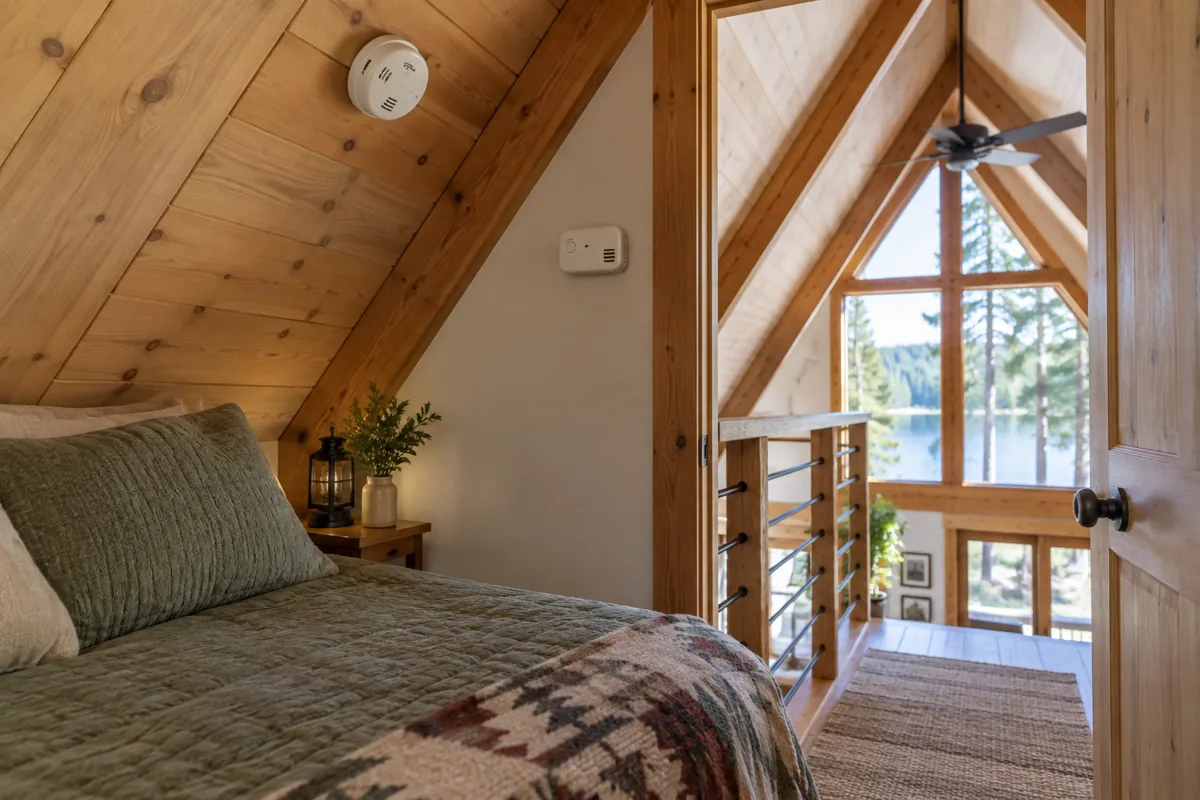
AI-generated cabin concept, used for illustration.
In this guide
Make an alarm plan for the whole cabin, including every sleeping area and level. Have the layout checked against local requirements and the chosen alarm instructions before installation.
Start with where people sleep
Mark enclosed bedrooms, the sleeping loft and any room routinely used by overnight guests. Do not assume one alarm near the main entrance covers every arrangement.
The US Fire Administration recommends smoke alarms inside bedrooms, outside separate sleeping areas and on each level. It also recommends interconnected alarms. For carbon monoxide, the US Consumer Product Safety Commission recommends alarms on every level and outside sleeping areas, with battery operation or backup.
Those are US safety recommendations. Your installer or local fire authority must confirm the applicable installation requirements, including the details for an unusual sloping ceiling.
Resolve the A-frame details
Ask where alarms belong relative to the peak, sloped surfaces, cooking equipment, fans and supply outlets. Use the alarm manufacturer's installation instructions; this article deliberately does not supply a universal distance from a ridge.
Check how each alarm can be tested and replaced safely. A position that requires an improvised ladder on a stair may create an avoidable maintenance problem. Discuss suitable access and any approved remote testing facility with the installer.
Keep smoke and CO functions clear
A combination product must explicitly provide both functions. A general air-quality monitor or humidity sensor should not be treated as a substitute for either alarm.
Make a register with the model, location, power source, manufacture date, replacement guidance and last test. Note how interconnected units behave when one activates. Anyone staying at the cabin should understand the signals and the escape plan.
Prepare for a remote location
Put the property address and emergency contact information where guests can find them. If a CO alarm sounds or CO exposure is suspected, move outside to fresh air and contact emergency services; do not stay inside to diagnose the appliance.
CPSC also warns against using generators indoors or in garages. Generator siting and operation must follow its safety guidance and the equipment instructions.
Add alarm checks to the project checklist and the cabin house manual. Revisit the plan when a loft becomes sleeping accommodation or a layout changes.