AI-generated cabin concept, used for illustration.
In this guide
Choose cabin hot water around the pattern of use. A few occupants showering close together can create a different demand from the same number of showers spread through the day.
Write a peak-use scenario
List the tasks that need hot water, their likely duration and which may overlap. Use the actual fixture flow information where available.
An illustrative shower at 6 liters per minute for 5 minutes uses 30 liters of mixed water. That is not automatically 30 liters drawn at the water heater's storage temperature. The heater selection needs inlet temperature, delivery temperature and the system's operating characteristics.
Your Home: hot water systems discusses matching water-heating choices to household demand. Its Australian market and regulatory information should not be treated as a product recommendation for every country.
Include how the cabin is occupied
Tell the installer whether visits are occasional, whether the building is shut down between stays and how quickly hot water is expected after arrival. Include freeze-related planning where relevant through the appropriate local professional.
Ask the quote to explain the selected capacity or output, energy source, connection requirements and maintenance access. For off-grid use, coordinate the electrical or fuel requirements with the broader service plan.
The useful brief is a normal-day scenario plus the busiest plausible sequence. It is more informative than choosing a heater by bedroom count alone or assuming the smallest advertised model will suit a small building.
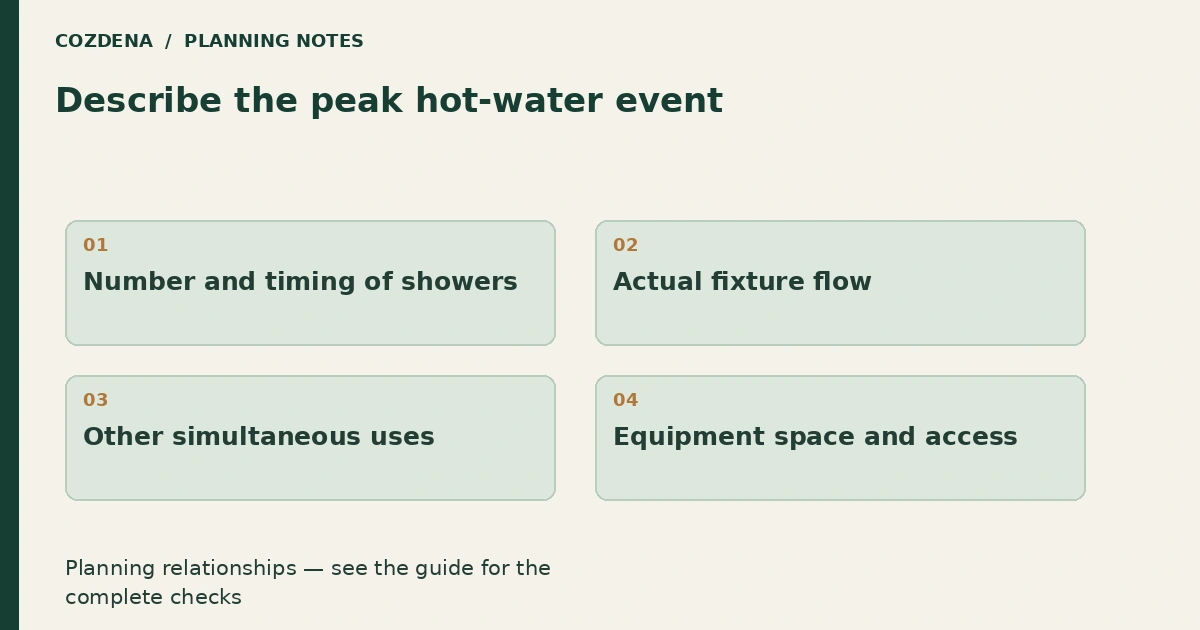
Describe the peak hot-water event
A daily total can hide a difficult short period. Write down the sequence of showers and other uses that the system is expected to serve, together with the selected fixture flows and the relevant incoming-water conditions.
For an illustrative four showers at 6 L/min for 7 minutes each, the mixed water delivered is 168 L. That is not automatically 168 L of water drawn at the heater's storage temperature. Mixing, temperatures, recovery and equipment behavior need to be considered by the designer.
| Information | Why it matters |
|---|---|
| Number and timing of showers | Establishes the peak sequence |
| Actual fixture flow | Avoids relying on a label from a different model |
| Other simultaneous uses | Identifies competing demand |
| Equipment space and access | Checks whether the proposed system fits |
Compare the service expectation before comparing tank sizes or nominal heater ratings. Read heat-pump water-heater space planning and appliance replacement access before finalizing the cupboard. Ask for commissioning and operating instructions for the installed system.