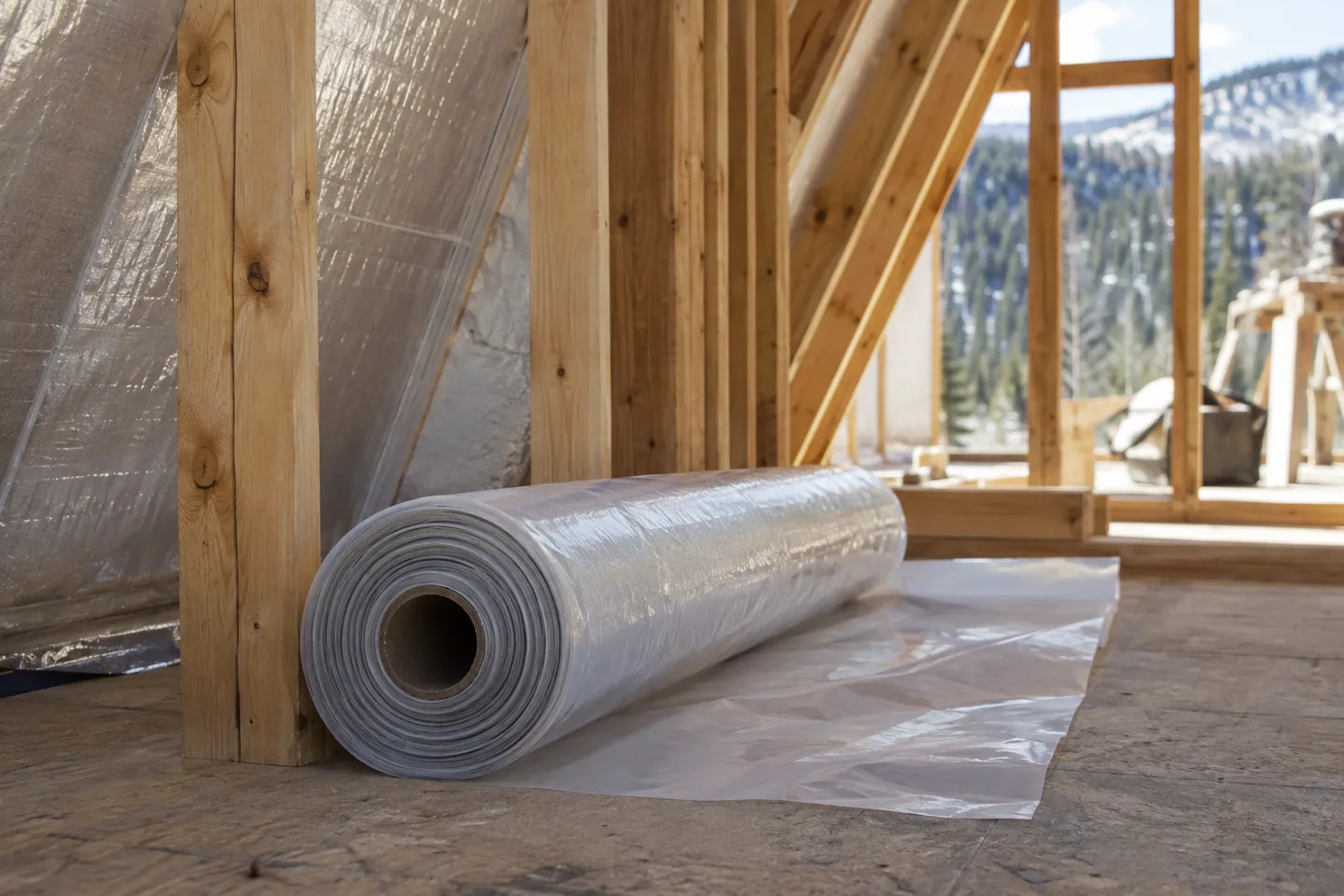
AI-generated cabin concept, used for illustration.
In this guide
There is no universal vapor-barrier position for every A-frame. The appropriate moisture-control strategy depends on climate, the complete assembly and how the cabin will be heated or cooled.
Separate the control functions
Water, air and water vapor do not move through buildings in exactly the same way. A layer may perform more than one function, but its role should be explicit in the design.
Your Home: condensation explains these distinctions and why condensation risk changes with construction and climate. Use the general concepts; its Australian product classes and construction examples are not universal specifications.
Ask the designer to label the purpose of each layer on the roof and wall sections. “Add a barrier” is not a sufficiently clear instruction for a contractor or material order.
Review changes before installation
If a supplier proposes a substitute product, ask whether its relevant properties suit the approved assembly. Similar appearance does not establish equivalent performance.
For an existing cabin, gather information about what is already present before covering the interior with another layer. Avoid choosing a material from a forum answer that describes a different climate or roof build-up.
The practical outcome should be a coordinated detail and a named person responsible for reviewing substitutions. Keep the specified products and installation records together. That gives a future assessor something concrete to examine if a moisture issue develops, rather than a series of hidden layers added at different times for different reasons.