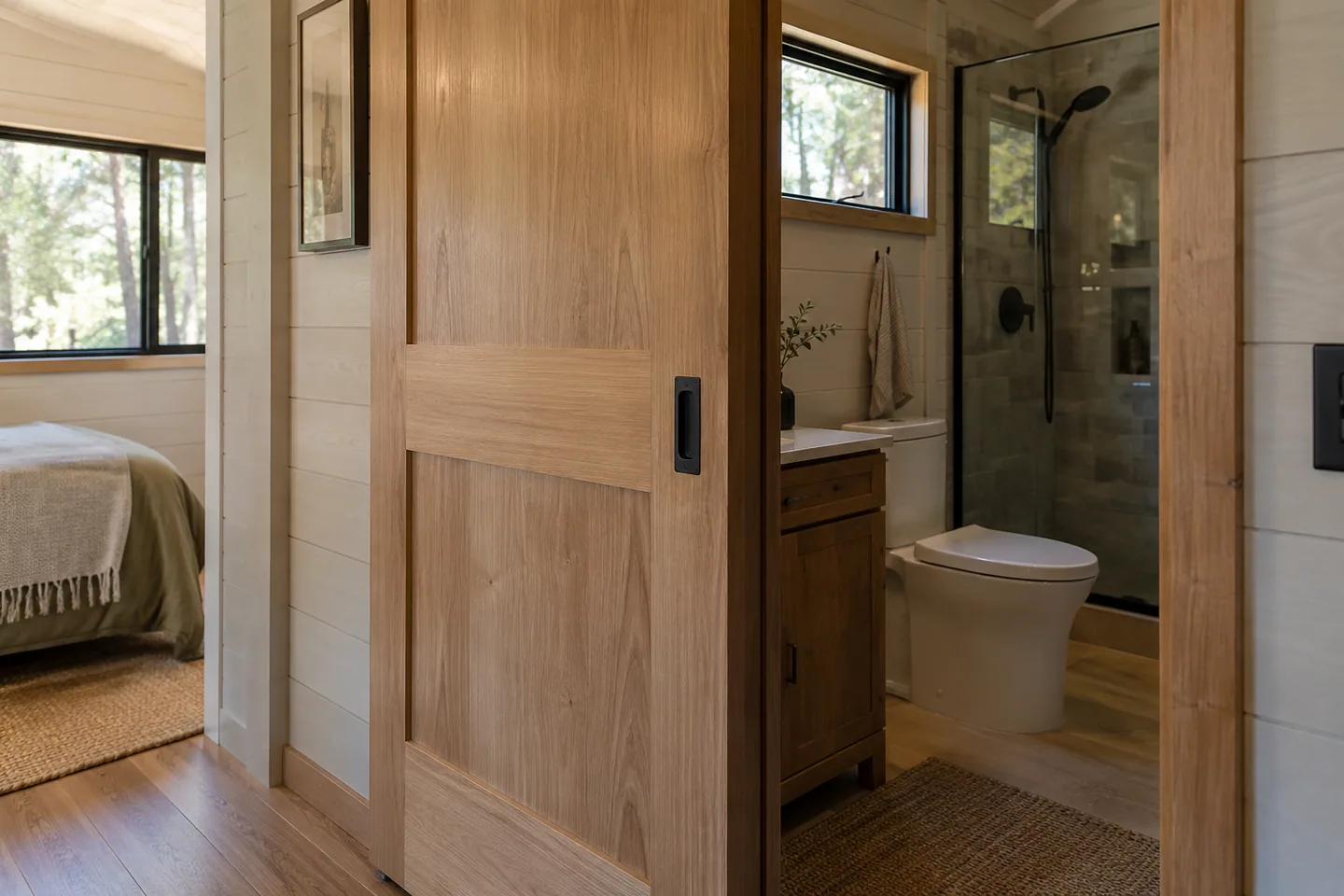
AI-generated cabin concept, used for illustration.
In this guide
A pocket door can remove a door-swing conflict, but it needs a suitable wall arrangement. Compare the complete installation with a hinged door rather than treating the disappearing panel as free space.
Draw both options fully
For the hinged option, show the open panel and everything it can conflict with. For the pocket option, identify the wall area occupied by the pocket and ask the installer what can or cannot share that construction.
Use the actual product's requirements for framing, hardware and installation. Do not route services or attach heavy objects to a proposed pocket wall without the appropriate design review.
Compare the daily experience
| Decision | What to test |
|---|---|
| Privacy | How the chosen door closes and how sound travels |
| Access | Whether the handle and operation suit the user |
| Furniture | Which wall or floor area each option occupies |
| Maintenance | How the hardware is reached if it needs attention |
Your Home: noise control provides background on sound paths; do not assume all door products offer equivalent acoustic performance.
For a bathroom, test the handle and closing action before buying if possible. For a bedroom, consider late-night movement and privacy alongside the saved swing area.
The best choice depends on the specific conflict. Sometimes moving a hinged door slightly solves the layout more simply. Sometimes a properly planned pocket system earns its extra coordination by keeping an essential route clear.