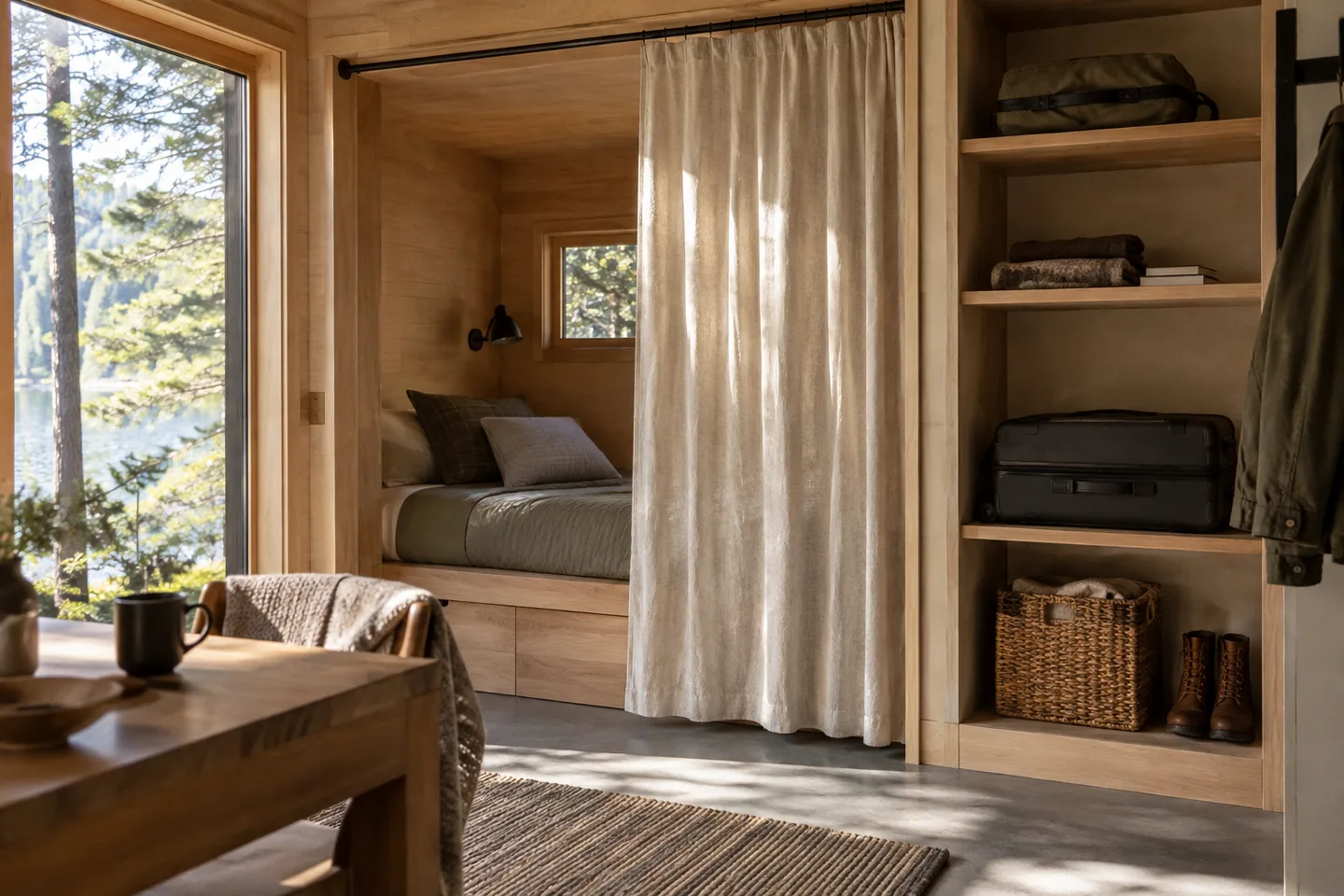
AI-generated cabin concept, used for illustration.
In this guide
Guest privacy starts with the route between sleeping, changing and using the bathroom. Adding a bed increases sleeping capacity, but it does not automatically create a comfortable guest arrangement.
Follow the nighttime route
Draw how a guest reaches the bathroom after others have gone to sleep. Note whether the route crosses another sleeping space or the middle of a living area still in use.
Then give the guest a place for a bag and clothing. A bed without nearby storage often pushes personal belongings into shared circulation space.
Compare three arrangements: an open sleeping area, a screened corner and a room with a door. Each offers a different level of visual separation. Do not describe a curtain as sound insulation; Your Home: noise control explains why sound control involves the construction and pathways as well as the room arrangement.
Test different schedules
Imagine one person reading late while another sleeps early. Can the shared room still function? Where does light spill, and which activities would need to stop?
For occasional guests, a convertible sleeping area may be an acceptable compromise. Make that choice deliberately, including the work of setting up and putting away bedding.
A clear description of the compromise is more useful than labeling every spare corner a bedroom. Plan for the number of people the cabin can accommodate comfortably in ordinary routines, then keep the furniture and storage consistent with that choice.